Smart Film for Glass Partitions
Switchable privacy for office partitions, meeting room enclosures, clinical screens, and demountable partition systems. Instant opacity on demand — without replacing the glass.

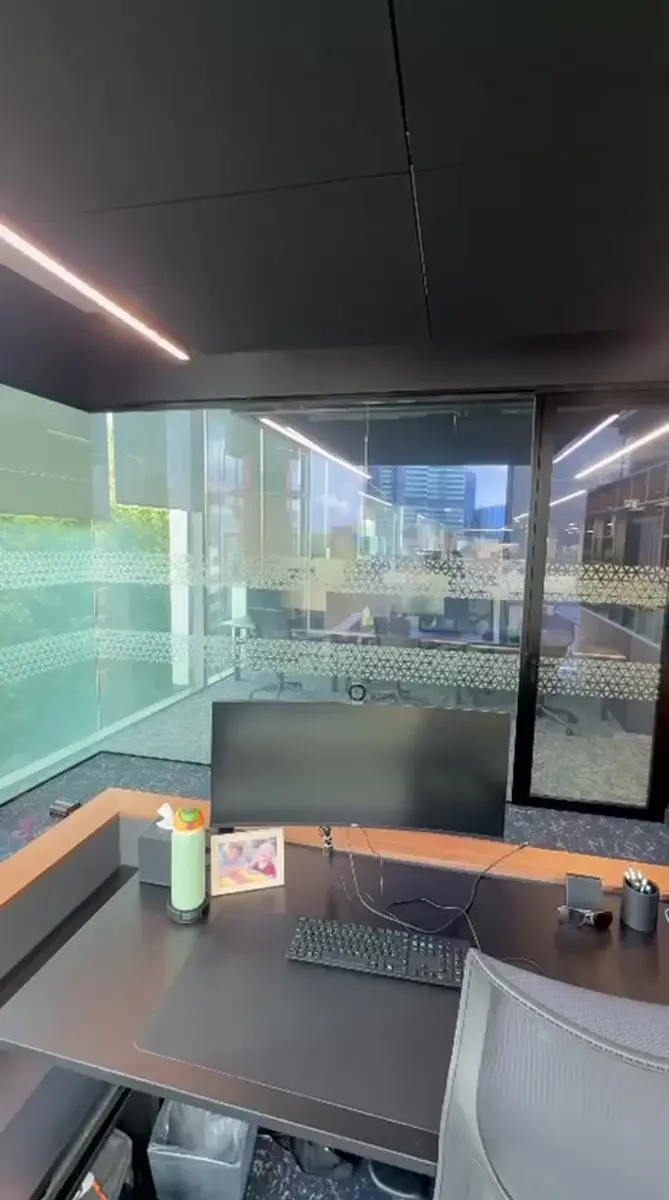
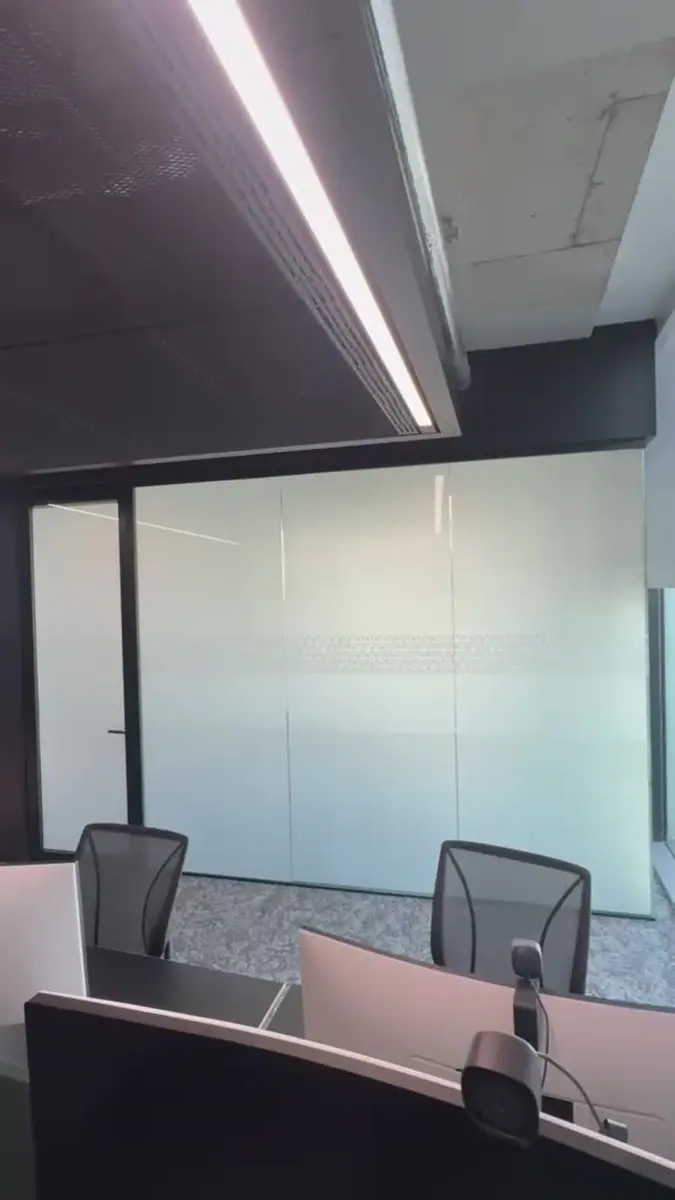
Instant privacy for a Central London office
We fitted PriviFilm to the existing meeting-room glass, giving the office clear views when open and instant privacy when required.
The Glass Partition Privacy Problem
Glass partitions are specified for transparency, light, and openness. The architectural intention is an environment that feels connected and collaborative — spaces that do not trap daylight or create visual barriers between teams. The problem arises when those same spaces also need to provide privacy: for meetings, for sensitive conversations, for clinical procedures, or for focused work that requires visual separation.
Traditional responses to this tension involve permanent compromise. Frosted glass provides privacy but eliminates the transparency the partition was specified for. Manifestation film reduces but does not remove transparency, and it does so permanently. Blinds or curtains add clutter and maintenance to spaces that were designed to be free of them.
Smart film resolves this without compromise. The partition is clearer when powered on for open sightlines and daylight. When privacy is needed, it returns to its translucent privacy state; exact optical values and switching performance depend on the selected grade and system. The specification serves both requirements without sacrificing either.
Related: Meeting Rooms · Smart Film vs Manifestations · Smart Film vs Frosted Glass
<1 second
Clear to opaque switching
3.7 W/m²
Power when energised
AC 60V
Operating voltage
>99%
UV blockage both states
Glass Partition Smart Film — Where It's Specified
Smart film for glass partitions is specified across commercial, healthcare, and education environments — wherever switchable privacy is needed without replacing the glazing.
Open-Plan Office Dividers
Glass partitions dividing open-plan floorplates benefit from switchable privacy for ad-hoc meetings, focused work, and sensitive conversations — without permanently reducing the open feel of the space.
Meeting Room Enclosures
Full-height partitioned meeting rooms with smart film switch to full opacity when occupied, returning to clear when vacant — maintaining sightlines and the sense of openness that modern offices prioritise.
Executive and Director Offices
Glass-fronted offices where the occupant requires discretion for phone calls, sensitive discussions, or client meetings. Instant privacy at the touch of a switch.
Hospital Ward Screens
Fixed glass partitions and window panels within clinical spaces. Smart film provides patient privacy on demand without the infection control challenges associated with fabric curtains.
SEN and Counselling Rooms
Spaces requiring visual separation from corridors and common areas during sensitive support sessions. Smart film provides immediate, reliable privacy without requiring the room to be fully enclosed.
Reception and Waiting Area Screens
Glass screens adjacent to reception desks or waiting areas can be switched to opaque during sensitive client interactions — maintaining an open, professional environment at all other times.
Smart Film Compatibility by Partition Type
Compatibility with common partition systems. Pre-installation survey confirms suitability for each specific project.
| Partition Type | Compatibility | Notes |
|---|---|---|
| Fixed Framed Partition | Yes | Standard application. Busbars concealed in partition frame. |
| Frameless / Structural Glass | Yes | Busbar concealment requires design consideration. Edge channels or beading recommended. |
| Demountable Partition (Steel Frame) | Yes — with planning | Cable routing must allow for future reconfiguration. Coordinate with partition supplier at design stage. |
| Demountable Partition (Aluminium Frame) | Yes — with planning | As above. Many modern aluminium systems have integrated cable channels — confirm with supplier. |
| Double-Glazed Partition Panel | Yes — inner face | Film applied to inner face of inner pane. IGU integrity maintained. Confirm with partition manufacturer. |
| Curved Partition Panel | Unlikely | Film requires flat glass surface. Gently curved profiles require case-by-case assessment. |
Pre-installation survey recommended for all commercial partition projects. Confirms glazing compatibility, electrical routing options, and busbar concealment detail.
Glass Partition Privacy — Smart Film vs Frosted vs Manifestation
The three main approaches to glass partition privacy — and what each delivers in practice.
| Criteria | Frosted Glass | Manifestation Film | Smart Film (PriviFilm™) |
|---|---|---|---|
| Privacy Mode | Permanent | Permanent partial | On demand — instant switching |
| Transparency When Not Private | None | Partial | 83–92% visible light transmission |
| Natural Light | Permanently reduced | Permanently reduced | Unaffected when clear |
| Infection Control | Smooth — wipe clean | Surface profile — harder to clean | Smooth — wipe clean |
| Design Flexibility | Fixed at manufacture | Fixed at application | Switchable; partial application possible |
| Specification Change | Glass replacement required | Film removal and reapplication | Control system adjustment only |
Specifying Smart Film for Glass Partitions — Key Decisions
Design and specification decisions that affect installation quality, aesthetics, and long-term performance.
Full Height vs Partial Application
Smart film can be applied to the full height of a partition or to a defined zone — for example, from floor to desk height or from 900mm to 2100mm. Partial application retains upper visual connection while providing seated privacy. Specify the required privacy zone at the design stage, not during installation.
Busbar Concealment
Electrical connections run along the film edges via copper busbars. In finished commercial spaces, busbars should be concealed within partition framing, decorative edge channels, or cover strips. For frameless glazing, specify a beading or trim detail to conceal the busbar. Exposed busbars are functional but visible — design them out early.
Demountable vs Fixed
Fixed partitions are treated as permanent installations — cable routing is planned once. Demountable partitions require cable routing that accommodates future reconfiguration. This is a fundamental distinction that affects electrical specification. Confirm partition type before designing the electrical installation.
Zone Control
Each independently switched zone requires its own transformer and control circuit. A partition with three distinct zones (e.g., lower panel, full-height panel, and door side panel) needs three control circuits. Zone control adds cost but allows different areas of the partition to be switched independently — valuable in open-plan environments.
Transformer Location
Transformers convert 230V mains to the AC60V the film requires. They should be accessible for maintenance but concealed from view. Ceiling voids above partitions, floor voids, and partition cavities are typical locations. Specify transformer locations during the M&E design stage — retrofitting access afterwards is disruptive.
Control System Selection
Wall switches are the simplest and most cost-effective option. For meeting rooms with booking systems, integration with Microsoft Teams Rooms or Condeco adds automated privacy management. For large floorplates, BMS integration enables centralised monitoring and energy management. Select the control system appropriate to the building's technology specification — not the most complex option available.
Questions to Ask Before Specifying Smart Film for Glass Partitions
Practical specification decisions that affect installation outcome.
Is the partition fixed or demountable?
This determines how the electrical installation is designed. Fixed: straightforward permanent cable routing. Demountable: cable runs must allow for future reconfiguration without cutting into the building fabric. The answer to this question affects everything downstream in the electrical specification.
Is full height or partial application required?
Define the privacy zone before quoting begins. Full height and partial application have different film quantities, busbar positions, and visual outcomes. A client expecting partial application who receives full-height film — or vice versa — has a specification error that requires remediation.
How will the busbar be concealed?
In any finished commercial or healthcare environment, exposed copper busbars are not an acceptable outcome. Specify the concealment method — partition frame integration, edge channel, beading, or trim — during the design stage. This affects partition supplier coordination and installation sequencing.
What control system does the client want?
A wall switch is simple and appropriate for most applications. BMS or room booking integration adds value in environments with automated building management. Specifying the wrong control system — either too simple or unnecessarily complex — creates a client expectation issue post-installation.
Where will the transformer be located?
Transformers need to be accessible for maintenance and concealed from view. Identify the location during design — ceiling void, floor void, partition cavity, or services cupboard. Discovering there is nowhere to put a transformer during installation is a programme-delay event.
Smart Film for Glass Partitions — Common Questions
Technical and practical questions from architects, contractors, and facilities managers.
When Smart Film May Not Be The Right Solution
Smart film is the correct specification for most privacy glazing applications — but there are scenarios where alternative solutions should be considered.
Blackout required
Smart film does not black out — it produces a bright white opacity when unpowered. If complete light exclusion is required (cinema rooms, photography studios, sleep environments), smart film should be combined with blackout curtains or blinds.
Variable tinting needed (not full privacy)
PDLC film switches between clear and opaque — it does not offer variable tint levels. If the requirement is light control without full privacy (atrium roofs, skylights, sunrooms), SPD (Suspended Particle Device) or electrochromic tinting may be more appropriate.
Curved or textured glass
Smart film is a flat substrate and cannot conform to curved, bent, or textured glass surfaces. For curved glazing, factory-laminated smart glass or alternative privacy solutions are required.
No electrical supply practical
Smart film requires a permanent low-voltage electrical connection. In listed buildings, conservation areas, or heritage properties where running new electrical circuits is prohibited or impractical, static privacy solutions (frosted film, manifestations) may be the only viable option.
Budget-constrained projects
Smart film has a higher upfront cost than static alternatives (frosted film, blinds, curtains). For projects where capital cost is the primary driver and switchable functionality is not required, static solutions provide privacy at lower initial expense.
Exterior glazing
Smart film is designed for interior application. Exterior exposure to weather, UV degradation, and temperature extremes reduces service life. For exterior switchable glazing, factory-laminated smart glass units are required.
Glass Partition Smart Film Enquiry
Site survey, specification support, and certified installer coordination for UK partition projects — commercial, healthcare, and education.
Explore the PriviFilm Ecosystem